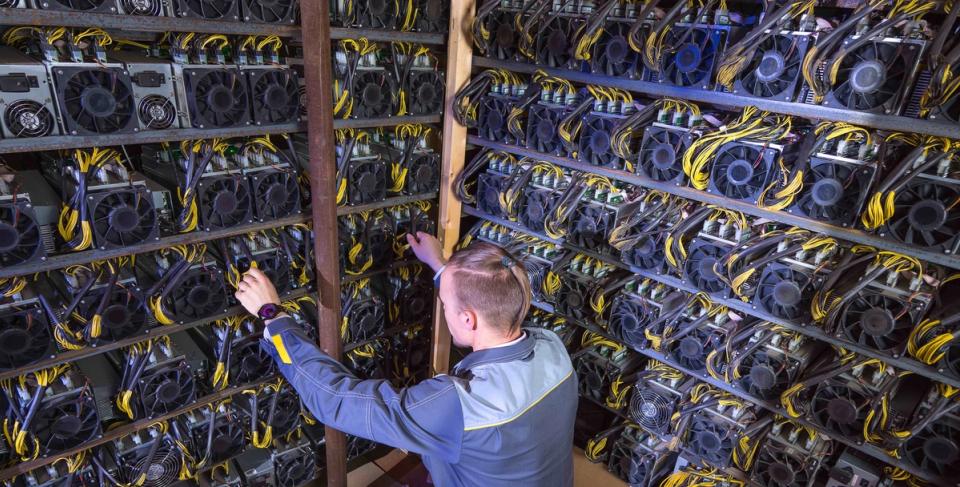
The stark contrast between a humming data center and the quiet whir of Bitcoin miners was palpable in Soluna Holdings’ latest earnings report.
Revenue at the digital infrastructure firm has surged by a remarkable 58% year-over-year, reaching $9.4 million for the first quarter. This marks the fourth consecutive quarter of sequential revenue growth for Soluna, a promising trend. Yet, beneath the surface of these headline numbers lies a clear strategic redirection. The company’s data center hosting business is now the undisputed star, generating $6.7 million in revenue, a figure that significantly dwarfs the $2.2 million brought in by its cryptocurrency mining operations. This isn’t just a minor adjustment; it’s a wholesale pivot.
This isn’t entirely surprising. The economics of Bitcoin mining have deteriorated considerably, particularly since the 2024 halving event. Adding insult to injury, the recent slump in Bitcoin prices has only exacerbated the pain for miners. A report from CoinShares indicated that a substantial portion—up to 20%—of Bitcoin miners might be operating at a loss, a grim reality for those relying on older, less efficient hardware. The hashprice, a crucial metric for miner profitability, has indeed seen sharper declines post-halving, dipping to post-halving lows earlier this year.
Is This Just a Temporary Blip or a Fundamental Shift?
Soluna’s move mirrors a broader industry trend. Across the digital asset landscape, publicly traded miners are increasingly reallocating capital and focusing their efforts on artificial intelligence (AI) and high-performance computing (HPC) infrastructure. Companies like HIVE Digital Technologies and TeraWulf are already on this path, signaling that AI isn’t just a side hustle; it’s becoming the main event for many in the crypto-adjacent tech space.
Even established analysts are taking note. Bernstein, for instance, has posited that companies like IREN are poised to derive the bulk of their future value not from digital asset mining, but from their burgeoning AI cloud businesses. Long-term agreements with tech giants like Microsoft are cited as key drivers for this transition. It’s a clear signal that the infrastructure built for the computationally intensive demands of blockchain is finding a second, and potentially more profitable, life serving the insatiable appetite of AI.
Data center hosting generated $6.7 million in revenue, while cryptocurrency mining contributed roughly $2.2 million, down from nearly $3 million the year before, as Bitcoin mining economics deteriorated.
Despite the impressive revenue growth, Soluna remains in the red. The company reported a net loss of $17.9 million, a widening from the $10.5 million loss seen a year prior. This expanded deficit is primarily attributable to increased stock-based compensation, higher interest expenses, and other financing costs. On the bright side, the adjusted EBITDA loss saw a modest narrowing to $2.1 million, suggesting some operational efficiencies might be taking root, or at least the bleeding is slowing.
Still, with $68.6 million in cash reserves at the quarter’s end, Soluna appears well-positioned to continue funding its infrastructure expansion. The company’s strategic focus on growing its AI and HPC business is not just a reactive measure; it’s a forward-looking strategy to tap into a market with potentially higher and more stable margins than the volatile world of cryptocurrency mining.
Why Does Soluna’s Pivot Matter?
This pivot is more than just Soluna’s story; it’s indicative of a fundamental evolution in the digital infrastructure sector. The very hardware and energy-intensive capabilities honed for Bitcoin mining are proving adaptable to the rapidly expanding demands of AI and HPC. For investors and industry watchers, Soluna’s performance offers a case study in how established players in one volatile tech niche are attempting to hedge their bets and capitalize on the current AI gold rush.
The challenge, of course, will be execution. Building out competitive AI data center capacity requires significant capital investment, technological expertise, and the ability to secure long-term, high-value contracts. Soluna’s continued unprofitability, even with soaring revenues, underscores the steep climb ahead. However, its current revenue trajectory and strategic focus certainly place it squarely in a sector experiencing explosive demand. It’s a high-stakes gamble, but one that appears to be paying off, at least in terms of top-line growth.
Soluna’s future hinges on its ability to fully transition from the unpredictable rhythms of Bitcoin to the steadier, albeit competitive, demands of AI compute. The numbers suggest they’re making the right moves, but the bottom line is where true success will ultimately be measured.