Here’s a number to chew on: $3 billion. That’s how much convertible notes Bitcoin miner IREN just cooked up. And they’re not planning to buy more servers to mine digital gold. Oh no. This mountain of cash is earmarked for… AI infrastructure. Yes, you read that right. The same companies that once powered digital currencies are now eyeing the artificial intelligence gold rush with a vengeance.
It’s a transformation story, they say. From Bitcoin farms to AI supercomputers. This isn’t just a tweak to the business model; it’s a full-blown existential rebranding. Following massive deals with titans like Nvidia and Microsoft, IREN is essentially betting the farm on AI. They’ve inked a $9.7 billion AI cloud hosting agreement with Microsoft and a $3.4 billion deal with Nvidia for air-cooled Blackwell GPUs. They even snagged a warrant for 30 million IREN shares from Nvidia. This isn’t dabbling; it’s diving headfirst into the silicon deep end.
The Art of the Pivot
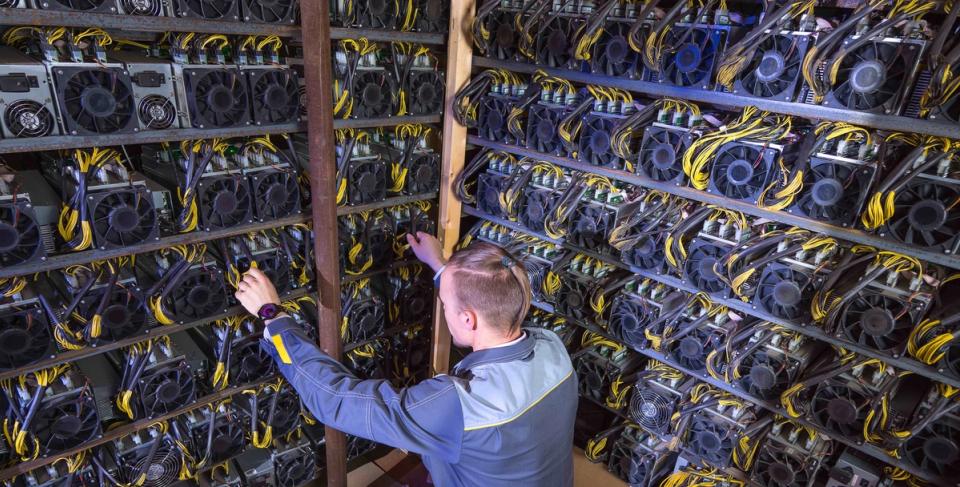
This dramatic shift from mining to AI compute isn’t unique to IREN, though the scale of their capital raise is staggering. Plenty of crypto miners, seeing the writing on the wall (or perhaps the rapidly appreciating value of AI chips), are scrambling to retool. They’ve got the power infrastructure, the cooling systems, the sheer physical footprint. Repurposing that for AI workloads seems… logical. Almost too logical, given the profit margins involved. Bernstein analysts are even calling for IREN to ditch Bitcoin mining entirely by 2030. It’s a stark image: fleets of ASICs gathering dust as new, far more powerful GPUs hum to life.
But let’s not pretend this is a smooth, gentle transition. Think of it as a desperate, high-stakes poker game. They’ve got the chips (convertible notes), they’ve got the table (their existing infrastructure), and they’re all-in on a new hand. The $3 billion infusion, after fees and capped call transactions, nets them a cool $2.96 billion. Enough to, you know, build a serious AI empire. Or at least try.
The convertible notes carry a 1% annual coupon and mature in 2033, with a conversion premium of 32.5% above IREN’s share price.
That 1% coupon on $3 billion? That’s $30 million a year in interest payments. The 2033 maturity gives them some breathing room, but convertible notes are a double-edged sword. If IREN’s stock soars because their AI gamble pays off, the noteholders will convert, diluting existing shareholders. If it tanks, well, they still owe that debt. The capped call transactions are meant to cushion that dilution blow, but it’s a complex financial dance designed to let them raise cash without immediately crippling their stock price. It’s financial engineering at its finest, or perhaps, most desperate.
Is This a Smart AI Play, or Just Mining FOMO?
Here’s the thing: Bitcoin mining is a brutally competitive, cyclical business. Margins get squeezed by energy costs and Bitcoin’s price swings. AI, on the other hand, is the new hotness. Demand for compute power is exploding, driven by generative AI models, machine learning, and all sorts of complex data crunching. Companies like Nvidia are printing money, and anyone with the infrastructure to support their chips is suddenly in the game. IREN’s move looks like a shrewd reaction to market realities. They’re chasing the money.
But this isn’t a walk in the park. Building and operating AI infrastructure is different from mining. It requires specialized cooling, advanced networking, and a highly skilled workforce. Can a company primarily built on ASIC hardware and electricity management make that leap? And are these partnerships with Microsoft and Nvidia truly sustainable, or just early, lucrative handshake deals? The $3.4 billion Nvidia deal, for example, is for five years. That’s a significant commitment, but in the fast-moving AI world, five years is a lifetime.
Why is IREN Pivoting Away from Bitcoin Mining?
The writing on the wall for Bitcoin miners has been visible for some time. The profitability of mining has always been tied to volatile cryptocurrency prices and the ever-increasing difficulty of finding new blocks. Furthermore, the energy consumption of large-scale mining operations has drawn significant regulatory scrutiny and public criticism. Meanwhile, the demand for high-performance computing (HPC) and artificial intelligence (AI) processing power has skyrocketed. Companies like IREN possess massive data center footprints and substantial power acquisition capabilities, assets that are highly transferable and valuable in the AI compute market. It’s a pragmatic business decision to shift resources towards a more stable and rapidly growing sector, especially when major tech players are willing to sign multi-billion-dollar deals.
IREN’s stock has seen its ups and downs, down over 8% on Friday amidst a broader crypto stock downturn, but up significantly over the last six months. This volatility is a constant companion for companies tethered to the crypto world. The real test for IREN won’t be the headlines about their $3 billion raise, but whether they can actually execute this massive AI transformation. It’s a gamble, sure, but in the frantic scramble for AI dominance, sometimes you’ve got to bet big.
🧬 Related Insights
- Read more: Drift’s $285M Solana Heist Exposes DeFi’s Dirty Secret: Code Isn’t Enough
- Read more: Coinbase’s Stablecoin Bet: Why a Senate Deal on Yield Could Reshape Crypto’s Future
Frequently Asked Questions
What does IREN do now?
IREN is transitioning from a Bitcoin mining company to an AI infrastructure provider, focusing on offering AI cloud hosting and compute services.
How much money did IREN raise?
IREN closed a $3 billion offering of convertible senior notes.