A quiet hum of trading activity, punctuated by the sharpest drop in privacy tokens in weeks, served as the starkest reminder: geopolitical tremors have a very real, and often immediate, impact on digital assets.
This isn’t just noise; it’s market mechanics at play. Zcash (ZEC) and Monero (XMR) — the darlings of the privacy coin set — saw declines of 5.2% and 4% respectively, a significant retracement after a period of notable strength. This isn’t entirely surprising. When global uncertainty ratchets up, particularly concerning energy supplies and broader economic stability, the risk-off trade often kicks in. And in the crypto world, privacy coins, while strong in their own right, can sometimes be early indicators of this sentiment shift.
Why Did Privacy Tokens Take the Biggest Hit?
Traders are framing this pullback in privacy tokens as classic profit-taking. After a sharp rally, fueled in part by institutional interest and a resurgence of the privacy narrative, a 5% drop often signals that early investors are locking in gains. The data supports this: structural buyers, those accumulating the tokens through the rally, are typically not distributing now. This suggests the selling pressure, while noticeable, is less about systemic fear and more about rebalancing portfolios after a strong run.
It’s a delicate dance. ZEC, for instance, is still up an impressive 8.2% over the past seven days, even after the session’s decline. Monero (XMR) also remains a strong performer on a weekly basis. These aren’t tokens collapsing; they’re high-flyers taking a breather amidst broader market jitters.
Dogecoin’s Fleeting Moment in the Sun
Meanwhile, in a bizarre turn of events that underscores the speculative froth still present in certain corners of the crypto market, Hyperliquid’s HYPE token briefly traded above Dogecoin’s market cap during Asian hours. This kind of transient outperformance, while attention-grabbing, often points to the hyper-speculative nature of some newer tokens. It’s a reminder that while fundamental narratives drive certain assets, pure hype can still create temporary, albeit unsustainable, market dislocations. HYPE eventually pulled back, down 4%, bringing its market dynamics back into a more recognizable — if still volatile — orbit.
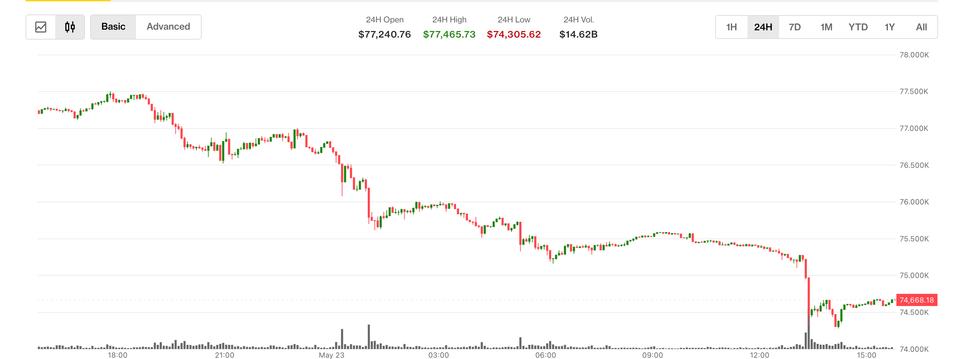
The broader crypto landscape was, by comparison, range-bound. Bitcoin held stubbornly near $76,500, Ethereum hovered around $2,087, and Solana clung to $83.97. These major assets, typically sensitive to macro shifts, seemed to be waiting for a clearer signal, caught in a holding pattern as the geopolitical dust settled.
The macro backdrop drove the cautious tone. US Central Command confirmed strikes on missile launch sites in Iran and boats attempting to place mines in the Strait of Hormuz, describing the action as defensive.
This statement from US Central Command is the linchpin. The confirmation of defensive strikes on Iranian missile launch sites and mine-laying boats in the Strait of Hormuz didn’t just spook traders; it directly impacted oil prices. Brent crude, which had slumped earlier in the week, bounced back almost 2% to $98 a barrel. The strengthening dollar against all G-10 peers and a pullback in gold further cemented the risk-off sentiment. S&P 500 futures also edged higher, indicating a cautious return to equities after the holiday closure, but the underlying tension remained palpable.
Is This a Sign of Things to Come for Crypto?
What’s truly fascinating here, and frankly, a bit concerning, is how quickly the market correlates these geopolitical events with asset performance. Weeks of gains in crypto were seemingly erased in a single session by news from the Middle East. It highlights a persistent vulnerability: crypto, despite its aspirations of decentralization and independence, remains tethered to traditional macroeconomics and geopolitical stability. The narrative that crypto is an inflation hedge or a safe haven often falters when genuine global instability looms. Instead, it acts more like a highly sensitive risk asset, amplifying both upside and downside.
The real question isn’t just about whether privacy tokens are correcting, but about the broader market’s susceptibility to external shocks. As long as the global stage remains volatile, expect these kinds of sharp, sentiment-driven swings in digital assets. The resilience of privacy coins after this dip will be a key indicator of whether institutional interest has created a more stable floor, or if they remain susceptible to the whims of international conflict.
🧬 Related Insights
- Read more: Crypto Charts: Is Bitcoin’s Rally Sustainable? [May 1st Analysis]
- Read more: [NEAR] Surges 19.4% As Crypto Index Stalls
Frequently Asked Questions
What caused Zcash and Monero to drop? Geopolitical tensions in the Middle East, specifically US strikes in Iran, increased oil prices and strengthened the dollar, prompting a risk-off sentiment that led to profit-taking in privacy tokens.
Did Dogecoin also fall? Dogecoin itself wasn’t directly mentioned as falling significantly. However, the Hyperliquid HYPE token briefly traded above Dogecoin’s market cap before pulling back, indicating speculative hype rather than a sustained move for Dogecoin.
Are privacy tokens a good investment right now? While privacy tokens like Zcash and Monero have shown strong performance recently, the recent drop suggests they are sensitive to broader market sentiment and geopolitical events. Investors should consider their risk tolerance and the current macro environment.