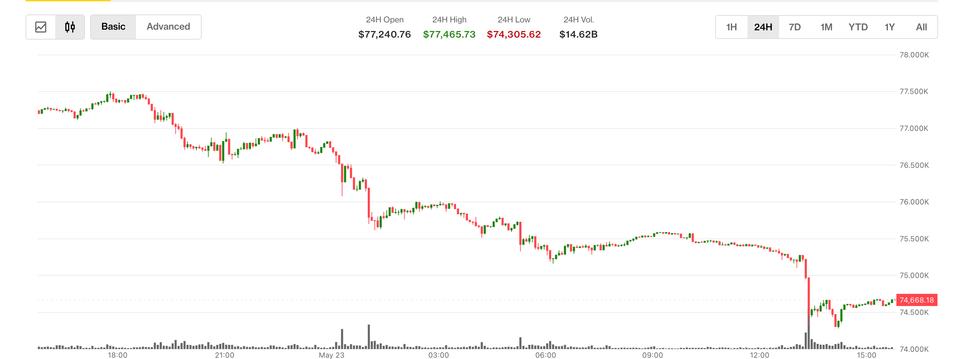
The digital currency market’s favorite darling, Bitcoin, just took a serious nosedive. Early Saturday, BTC was flirting with $74,305, a chilling 10% drop from its early May highs. And as you read this, it’s down another chunk.
This isn’t some random dip; it’s a clear signal that speculative capital is getting skittish. Why? Blame Uncle Sam’s bond market. U.S. Treasury yields are climbing, and frankly, so are bond yields everywhere else. Suddenly, those high-risk, zero-yield digital assets look a lot less appealing when you can get a decent return on something as boring—and presumably safe—as a government bond. It’s the age-old trade-off: risk versus reward, and the scales are tipping.
Let’s talk numbers, because that’s where the real story is. U.S.-listed spot Bitcoin ETFs are hemorrhaging cash. We’re talking a staggering $2.26 billion in outflows over just two weeks. This past week alone saw a whopping $1.26 billion vanish—the biggest single-week exodus since January. The previous week wasn’t much better, with around $1 billion packed up and shipped out.
So, where’s all this money going? It’s not vanishing into the ether. The whispers are that speculative money is chasing more tangible (or at least, more dramatically disruptive) plays. Think commodities like oil, copper, and sulfur. The ongoing geopolitical tensions, particularly around the Strait of Hormuz, are making these look like attractive bets for investors hedging against potential supply shocks. Who needs a blockchain when you can bet on a tanker getting stuck?
And then there’s the SpaceX IPO gravy train. Some of the smarter money, or perhaps just the more adventurous, is apparently parking itself in pre-IPO bets. We’re seeing millions traded on blockchain-based derivatives linked to SpaceX’s future public debut. It’s a modern twist on an old Wall Street game – trying to get in on the ground floor before the real party starts.
Is This Just Another Bitcoin Cycle?
Look, I’ve seen these cycles before. The hype builds, the money floods in, and then… reality bites. The initial allure of Bitcoin ETFs was supposed to be broad accessibility, a way for your average Joe to get in on the crypto action without the headache of managing private keys. And for a while, it worked. Demand was insane.
But now? The narrative is shifting. It’s not just about the tech or the potential decentralization anymore; it’s about macroeconomic forces and competing investment opportunities. The ETFs became a convenient exit ramp for those looking to lock in profits or simply de-risk their portfolios. It’s a reminder that even the most hyped digital assets are still tethered to the traditional financial world, for better or worse.
When you see billions flowing out of these products, it’s not just a technicality; it’s a statement. It means the institutional money that initially poured in might be re-evaluating. Or, more cynically, it means the early birds are cashing out, and the latecomers are left holding the bag.
Who is actually making money here? Well, the ETF issuers likely made a pretty penny on management fees while the money was flowing in. The exchanges that list these ETFs benefit from the trading volume. And, of course, anyone who sold their Bitcoin at the peak is feeling pretty good right now. For everyone else caught in this downdraft? It’s a painful reminder that crypto, like any speculative asset class, is a wild ride.
Why Are Bond Yields Ruining Crypto’s Party?
This is textbook financial 101. When bond yields rise, they offer a more attractive risk-free return. Imagine you have $100 to invest. You can put it in Bitcoin and hope it goes up, knowing it could also plummet by 20% overnight. Or, you can put it in a U.S. Treasury bond and know you’ll get a guaranteed, albeit lower, return with virtually no risk. For a lot of investors, especially those managing large sums, that guaranteed return becomes incredibly appealing when it starts to creep up.
Bitcoin, lacking any intrinsic yield, relies heavily on momentum and the speculative belief that its price will continue to climb. When that belief wavers—often triggered by a less risky alternative looking more enticing—the selling pressure can become immense. It’s like a crowded theater when someone shouts ‘fire’; everyone scrambles for the exit, and the safest path out is often the one with the least immediate risk.
The Future of Bitcoin ETFs
It’s too early to declare the Bitcoin ETF era dead. These products are still relatively new, and their performance will undoubtedly be tied to the broader market sentiment around cryptocurrencies. We’ve seen significant inflows since their launch, indicating sustained interest. However, this recent bout of outflows serves as a stark dose of reality. The “fear of missing out” that drove initial adoption can easily morph into “fear of losing everything” when the tide turns.
Expect more volatility. Expect continued scrutiny. And expect the narrative around Bitcoin to keep evolving, from a revolutionary digital currency to a macroeconomic play, depending on the day of the week and the latest yield curve.
Frequent Asked Questions