The familiar green glow of a trading chart illuminating a face in the pre-dawn dark.
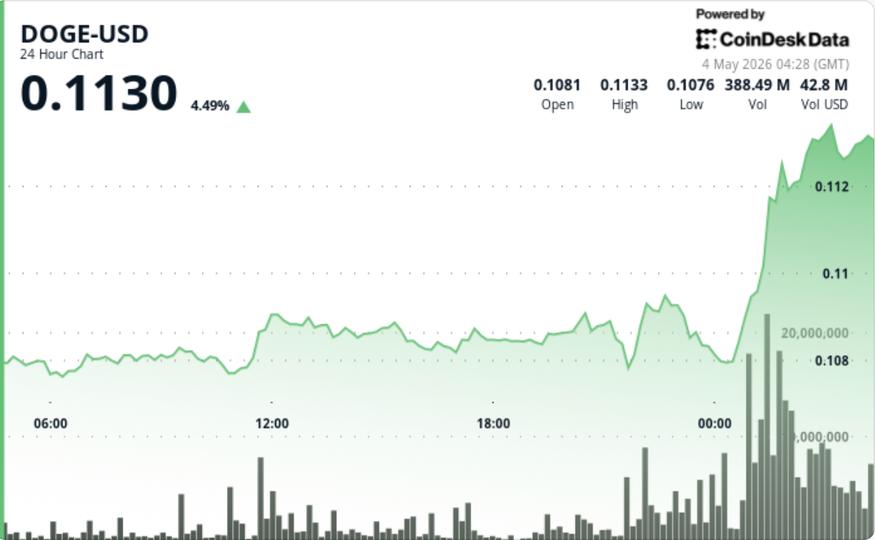
That’s often the scene for crypto traders, and this week was no different for Dogecoin enthusiasts. The meme coin, often a barometer for broader market sentiment, has just performed a sudden, high-octane leap, breaking past the $0.109 level. This isn’t just any incremental gain; it’s a move that happened in a single, powerful surge of volume, propelling it alongside Bitcoin’s own dramatic ascent past $80,000.
The Architecture of the Jump
Here’s the thing about these crypto rallies: they rarely just happen. They’re built on a confluence of factors, and for DOGE this week, it was a potent cocktail. Bitcoin, the undisputed king of the digital asset world, decided it was time for a sprint, crossing the psychologically significant $80,000 threshold. This kind of upward momentum in Bitcoin has a domino effect, invariably pulling the rest of the market – the so-called altcoins – along for the ride. Dogecoin, being one of the most recognized and actively traded altcoins, often amplifies this effect.
But the real story here, the one that sets this DOGE surge apart from mere market drift, is the nature of the breakout. The original report highlights a “sharp volume spike” driving the price from around $0.1075 to $0.1119. This isn’t the slow, steady climb that suggests broad-based retail accumulation. No, this is the signature of concentrated buying, likely from larger players or a coordinated effort, pushing through a significant resistance level. Think of it less like a flock of birds taking flight and more like a single, powerful engine igniting.
The move came in a single high-volume burst from about $0.1075 to $0.1119, suggesting concentrated buying rather than gradual retail interest.
This technical signal is crucial because it suggests conviction. When volume spikes with price, it validates the move. The question now becomes: can this level hold?
The $0.109 Crucible: Support or Resistance?
Technical analysts are all over this. The $0.109 level, which had previously acted as a ceiling for DOGE’s price, is now the vital point. The game theory is simple: if buyers can maintain their positions and the price stays above $0.109, that former resistance is likely to transform into a new support level. This is the holy grail for a breakout – the old ceiling becoming the new floor, providing a solid launchpad for further gains. The next significant hurdle, should momentum persist, lies at $0.114.
However, the crypto market is a fickle beast. A swift retreat below $0.109 would signal a failed breakout, a trap for those who jumped in too early, and a return to the previous trading range. The current momentum appears strong, with the Relative Strength Index (RSI) climbing, indicating buying pressure. Yet, as the report cautions, the move is becoming “stretched.” This suggests that while the immediate sentiment is bullish, the market is getting a bit overheated, and a consolidation period or even a minor pullback wouldn’t be surprising.
The Underlying Fragility?
This brings us to a more critical, often overlooked, aspect of these rallies. While Dogecoin’s 4% jump is headline-grabbing, the underlying forces lifting Bitcoin – and by extension, the entire crypto market – are worth scrutinizing. The accompanying note about Bitcoin’s performance points to a crucial distinction: strong inflows into U.S. spot ETFs and use long positions are driving the price. This is not necessarily indicative of a surge in fundamental demand from everyday users buying crypto with their own money.
On-chain data, as mentioned, suggests that April’s rally was powered “almost entirely by perpetual futures demand while spot demand contracted.” This is a red flag. Perpetual futures are derivatives that allow traders to bet on price movements with use. While they can amplify gains, they also amplify losses and can lead to highly volatile, easily reversed price swings. A market rally driven primarily by use bets rather than actual spot buying is inherently fragile. It’s like building a skyscraper on a foundation of Jell-O.
My unique insight here is to draw a parallel to the dot-com bubble. During that era, vast sums of money flowed into internet companies based on speculative fervor and the idea of future profits, often with little regard for sustainable business models or actual revenue. Today, we see a similar dynamic in crypto. The inflows into ETFs and the rise of use trading create an illusion of broad-based adoption and intrinsic value, when in reality, the underlying demand from end-users and real-world utility might be lagging far behind the speculative frenzy.
This isn’t to say Dogecoin’s jump is meaningless. It’s a proof to the enduring speculative appetite in crypto and the potent influence of Bitcoin’s price action. However, investors and traders would be wise to look beyond the percentage gains and understand the mechanisms driving them. The question isn’t just if Dogecoin will move higher, but why it’s moving, and more importantly, how sustainable that movement truly is. The next few days, watching whether $0.109 holds as support, will offer a clearer picture.
🧬 Related Insights
- Read more: a16z Crypto: ‘Stablecoins’ Outdated? Think ‘Digital Cash’
- Read more: SpaceX IPO Could Drain Crypto: Here’s Why
Frequently Asked Questions
What’s the significance of Dogecoin jumping 4%? It signifies a bullish short-term momentum for DOGE, driven by Bitcoin’s rally and a strong technical breakout above a key resistance level at $0.109.
Is the Dogecoin price jump driven by real demand? The report suggests the current rally is more fueled by speculative trading and use positions, particularly in Bitcoin, rather than broad-based spot buying.
Will Dogecoin reach $1? While speculative rallies can be dramatic, reaching $1 would require a sustained, massive increase in adoption and utility beyond its current meme status, which is a significant hurdle given current market dynamics.