A trader’s screen flickers with the relentless, narrow trading band of Bitcoin, a digital heartbeat stuck in neutral.
This isn’t just any pause; it’s a high-stakes game of mathematical brinkmanship. Bitcoin is currently getting squeezed, caught between the sturdy bedrock of on-chain support and the sharp, strategic edges of a massive options expiration event. Think of it like a meticulously built sandcastle, just as the tide is both pushing in with a steady surge and threatening to pull back with an equally powerful, calculated sweep.
And here’s the thing: this isn’t just about the price of Bitcoin today. It’s a fascinating snapshot of how sophisticated financial mechanics are increasingly shaping the trajectory of this nascent asset class. We’re talking about millions of dollars, complex strategies, and the very real possibility of market makers nudging prices to their advantage.
The core of the issue lies in a massive concentration of Bitcoin supply. More than 15% of all BTC has been accumulated in the not-so-wide range between $74,000 and $83,000. This isn’t just a lot of coins; it’s a dense cluster, creating a sort of magnetic field that’s hard to break through. When so much supply is held in such a tight band, it naturally resists dramatic price swings, acting like a shock absorber for volatility. And right now, that shock absorber is in overdrive.
But that’s only half the story. The other half is an impending options expiry on Deribit, a behemoth in the crypto derivatives space. We’re talking about a staggering $6.6 billion in open interest set to vanish on May 29th. This isn’t chump change. It’s the kind of sum that gets the attention of the big players, the market makers whose job it is to balance the books and manage risk.
And these market makers? They have a vested interest in keeping Bitcoin’s price pinned. Why? Because the largest chunks of open interest are clustered around the $75,000 put options and $80,000 call options. For them, it’s far simpler, and often more profitable, to keep the price somewhere in the middle, between these two significant strike prices, as expiry approaches. It’s like playing a game of financial chess, where the pieces are moved not just by market forces, but by the very structure of the contracts themselves.
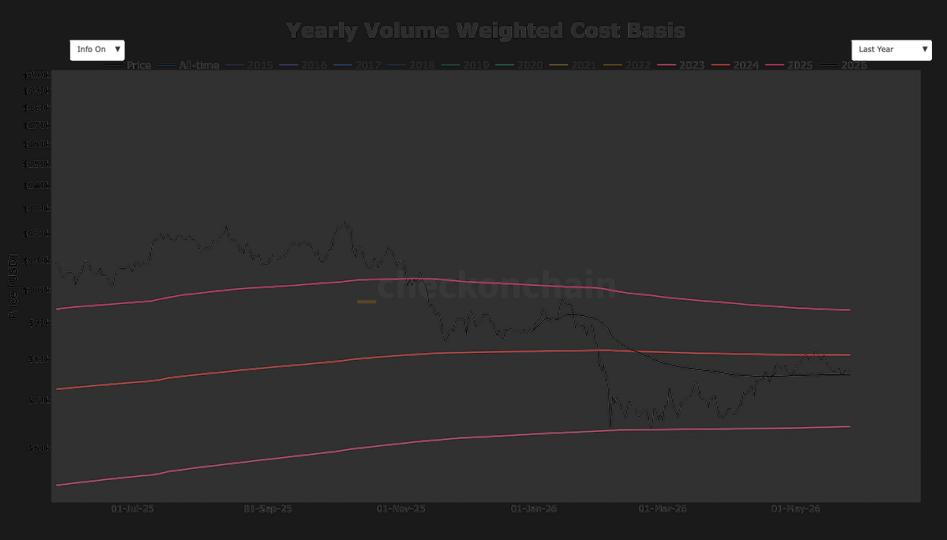
This dance between on-chain realities and options expiry pressures is what’s creating this unusual period of suppressed volatility. Bitcoin has flirted with its 128-day moving average near $74,500, finding some solace there, and indeed, it managed to rebound. This moving average, like the realized price we’ll touch on, is more than just a line on a chart; it represents a historical point of price discovery that traders actively watch. Yet, it’s still struggling to break past key on-chain resistance levels hovering around $77,000. These aren’t arbitrary numbers; they represent significant cost bases for different groups of holders – the true market mean and the short-term holder cost basis. When price is below these, it signals that a significant portion of the market is underwater or at best, treading water, which can dampen buying enthusiasm.
It’s fascinating to see how these on-chain metrics, like the realized price, have grown in importance. For those unfamiliar, the realized price acts as a sort of aggregate cost basis for all Bitcoin that has moved recently. It’s a more grounded measure than traditional psychological price points. Back in February, when Bitcoin dipped significantly, it found a strong floor near the 2023 realized price. This reinforced the idea that these cost-basis levels are becoming powerful anchors in the market’s structure, guiding price action with a digital gravity all their own.
My unique insight here? This isn’t just a Bitcoin story; it’s a harbinger of how traditional finance mechanics will be overlaid onto digital assets with increasing sophistication. We’re seeing the financial engineering of Wall Street being rapidly adapted and applied to the crypto markets. The options expiry strategy, while common in traditional markets, takes on a new dimension in a 24/7, globally accessible digital asset environment. It’s a sign that crypto is maturing, not just in adoption, but in its financial plumbing.
Why This Options Showdown Matters
The upcoming Deribit expiry is more than just a date on the calendar; it’s a potential catalyst. A significant move on either side of the $75,000-$80,000 range could unwind a substantial amount of these options contracts. If Bitcoin breaches the $80,000 call resistance, it could trigger a cascade of buying as options holders seek to benefit from further upside, potentially accelerating the price move. Conversely, a sharp drop below $75,000 could lead to significant pain for put option holders, and potentially, forced selling as market makers adjust their hedges. It’s this dynamic, the potential for rapid shifts in market sentiment and liquidity based on the expiry of these contracts, that makes this particular event so closely watched.
Will This Keep Bitcoin Stuck?
Predicting the exact outcome is a fool’s errand. However, the forces at play suggest that until this options expiry passes and the significant supply concentration is either absorbed or fundamentally shifts, Bitcoin will likely remain in a relatively tight range. The market makers’ incentive to pin the price is substantial. Breakouts are possible, of course, especially if a significant macro event or unexpected on-chain development occurs. But based purely on the current technical and options landscape, expect continued consolidation or choppy trading until the $6.6 billion contract expiry on May 29th.
We’re witnessing the evolution of Bitcoin from a speculative bet to a complex financial instrument, deeply integrated with derivatives markets. It’s a sign of its growing maturity, and frankly, a little bit exhilarating to watch.
**
🧬 Related Insights
- Read more: Revolut’s Bitcoin Glitch: A Blip or Warning?
- Read more: JPMorgan’s Crypto Reality Check: $11 Billion Q1 Flows Are a Screaming Signal Nobody Wants to Hear
Frequently Asked Questions**
What is onchain support for Bitcoin? Onchain support refers to price levels on the blockchain where Bitcoin has historically found buying interest or where a significant portion of holders have their cost basis. Metrics like the realized price and short-term holder cost basis are key indicators of this.
How do options expiries affect Bitcoin price? Large options expiries can influence price as market makers, who are obligated to fulfill these contracts, may act to keep the price within a specific range to minimize their risk and maximize their profits. This can lead to periods of reduced volatility or sharp moves around the expiry date.
What is the realized price of Bitcoin? The realized price represents the average acquisition cost of all Bitcoin that has been transacted on the blockchain, providing a more grounded measure of market sentiment than simple price charts.