Everyone expected Ether to bounce back, to reclaim its throne as the volatile darling of the crypto world, especially after the seismic success of Bitcoin ETFs. The narrative was set: institutional money pouring into Bitcoin would eventually trickle down, lifting Ether and the broader altcoin market with it. But here’s the thing – the charts are telling a different story, a story that’s got many feeling a distinct chill.
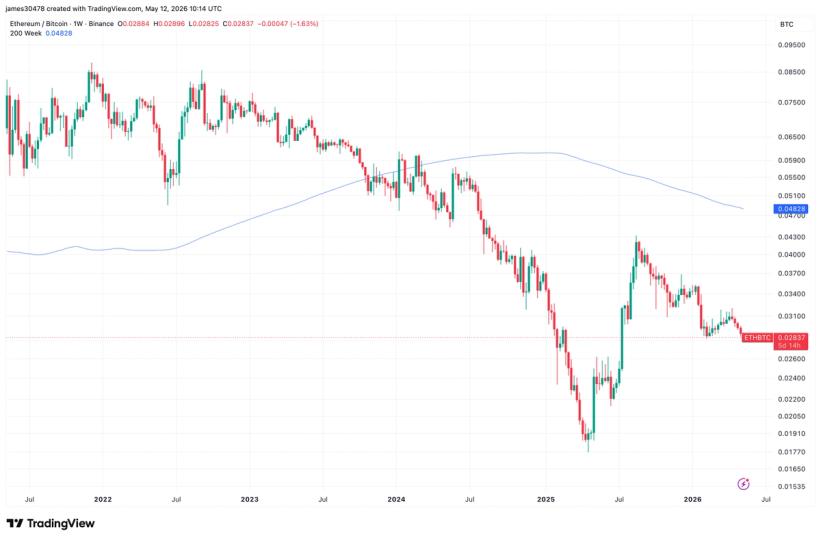
We’re talking about the ETH/BTC ratio, the unsung hero of crypto market sentiment analysis. On Tuesday, this critical gauge plunged to 0.02835, a level we haven’t seen since July of last year. That’s a significant drop, a more than 35% slide from its August peak. It’s like watching the tide go out, revealing a lot of exposed seabed that wasn’t there a month ago.
What does this mean? Simply put, investors are ditching Ether in favor of Bitcoin. This isn’t just a minor wobble; it’s a clear signal of weakening risk appetite. When the going gets tough, or even just a little uncertain, money flows to the perceived safe haven. In the crypto universe, that safe haven, however paradoxical it sounds, is Bitcoin.
This ratio acts like a barometer for our collective digital nerves. A rising ETH/BTC ratio usually screams ‘risk-on,’ meaning investors are confident, eager to grab higher-yield, higher-risk assets like Ether. But a falling ratio? That’s the whisper of caution, the subtle nod towards Bitcoin’s relative stability. It’s the crypto equivalent of packing away the party hats and putting on a sensible cardigan.
The ETH/BTC ratio measures ether’s relative performance against bitcoin across crypto exchanges and is considered a key gauge of market risk appetite.
We saw this pattern play out dramatically after the launch of U.S. spot Bitcoin ETFs in January 2024. That was the accelerant, pouring institutional fuel onto Bitcoin’s already simmering fire, causing the ETH/BTC ratio to soar. But then, like a roller coaster cresting its highest point, it began its descent. Even a rebound later in the year couldn’t stave off the current downtrend.
Technically speaking, the picture is stark. The ratio is sitting well below its 200-week moving average – a long-term trend indicator. This reinforces the idea that Ether is in a protracted bear market relative to Bitcoin. It’s not necessarily that Ether is fundamentally broken, but that Bitcoin, for now, is simply the more attractive horse to back.
Is Bitcoin the New Digital Gold Standard?
This divergence, this persistent underperformance of Ether against Bitcoin, begs a larger question: Is Bitcoin solidifying its position not just as digital gold, but as the only digital asset that truly matters in times of macro uncertainty? The narrative of Ether as the platform for decentralized innovation is compelling, but if capital is consistently flowing away from it towards Bitcoin when markets get choppy, that narrative faces a significant headwind.
It’s almost like comparing a vibrant, bustling city with a thousand different projects and opportunities (Ether) to a well-fortified, ancient citadel (Bitcoin). When the storm clouds gather, people tend to head for the citadel, even if the city offers more immediate excitement.
The recent news about the Roundhill Sports Betting & iGaming ETF (BETZ) and its strong correlation with Bitcoin, but with BETZ often leading the charge, adds another layer to this evolving picture. It suggests a broader market sentiment that, while exhibiting a preference for Bitcoin, is also sensitive to trends that might precede broader risk-on movements. However, the current ETH/BTC slide suggests that even these pre-cursors aren’t enough to pull capital away from BTC’s gravitational pull.
This isn’t the end of Ether, by any stretch. The technology is still mind-blowingly innovative. But it is a powerful reminder that in the volatile world of cryptocurrency, perception and capital flows often dictate short-to-medium term performance. Right now, perception is firmly skewed towards Bitcoin’s perceived safety.
Why Does This Matter for Crypto Investors?
For anyone playing in the crypto sandbox, understanding this ETH/BTC dynamic is crucial. It’s not just about picking the next big altcoin; it’s about understanding the fundamental flow of capital within the crypto ecosystem. A declining ETH/BTC ratio signals a risk-off environment, which typically means broader altcoin markets will also struggle. Investors might need to temper expectations for altcoin rallies and focus on capital preservation or doubling down on Bitcoin.
It’s the difference between betting on a speedboat to outrun a storm or sticking with a sturdy, if slower, freighter. Right now, the market seems to be choosing the freighter.
🧬 Related Insights
- Read more: Fintech’s Frenzied Week: C-Suite Swaps, Stablecoin Dreams, and Insurtech Handshakes
- Read more: The Surplus Mirage: Why DB Pension Run-Ons Demand Ironclad Guardrails
Frequently Asked Questions
What does the ETH/BTC ratio actually represent?
The ETH/BTC ratio is a trading pair that shows how many units of Bitcoin are equivalent to one unit of Ether. It’s used to gauge Ether’s relative strength or weakness compared to Bitcoin in the crypto market, reflecting investor sentiment towards riskier assets versus perceived safer ones.
Why are investors favoring Bitcoin over Ether right now?
Several factors contribute, including the successful launch and ongoing inflows into U.S. spot Bitcoin ETFs, which have attracted institutional capital. Additionally, in times of market uncertainty, investors often retreat to Bitcoin as a perceived ‘safe haven’ asset within the crypto space.
Will the ETH/BTC ratio recover soon?
While past performance isn’t indicative of future results, a sustained low ETH/BTC ratio suggests a bearish trend for Ether relative to Bitcoin. A recovery would likely require a significant shift in market sentiment, renewed institutional interest in Ether-specific narratives, or a broader macroeconomic environment that encourages risk-taking.