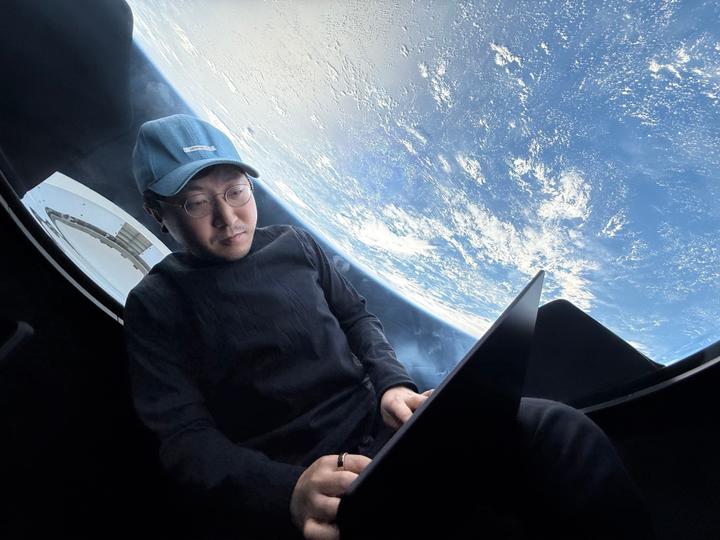
When does your investment portfolio start funding interplanetary real estate? For Chun Wang, co-founder of F2Pool, one of the earliest Bitcoin mining operations, that question is no longer hypothetical. SpaceX has officially tapped Wang to command the inaugural private crewed mission to the Red Planet, a move that blurs the lines between digital asset accumulation and extraterrestrial ambition.
This isn’t just some vanity project announced at a crypto conference; it’s a concrete — albeit highly speculative — step toward Elon Musk’s grand vision of a Mars colony. The announcement, delivered during a livestream of a Starship V3 launch attempt that was ultimately scrubbed, placed Wang squarely in the pilot’s seat for a journey that, at present, hinges on technology still in its nascent stages.
“A lot of people [are] talking about the whole Mars to be like we’re going to fly to Mars, we’re going to land on Mars, we’re going to build [a] city on Mars,” Wang said in a recorded video from the remote Bouvet Island in the South Atlantic. “But let’s get it started with a flyby.”
This proposed flyby, while less ambitious than a landing, is still a monumental undertaking. Wang isn’t exactly a novice to spaceflight. Last year, he funded and captained Fram2, a three-day polar orbit mission aboard a SpaceX Crew Dragon. He described the experience with a pragmatist’s flair: “Space was great. I already read a lot about space all my life, and I just went there for verification… So, don’t trust, verify. I verified space.” That kind of empirical approach is precisely what’s needed when you’re talking about a round trip to Mars.
Starship: The Rocket to Redemption (or Ruin)?
The vehicle in question is SpaceX’s Starship, the behemoth designed for interplanetary travel. It’s the largest, most powerful rocket ever constructed. The problem? It hasn’t actually reached orbit yet, nor has it carried astronauts. This is the critical asterisk hanging over Wang’s Mars debut. For all the billionaire bravado and visionary pronouncements, the fundamental engineering hurdles remain. SpaceX’s ambitious timelines, particularly for human landings, have historically been — shall we say — optimistic. Musk himself has floated timelines for uncrewed Mars cargo flights by the end of 2026, with human landings not until 2029. That’s a stark contrast to the immediate implications of Wang’s appointment.
Wang, however, seems unfazed by the vast distances and extended isolation. His past flight experience, coupled with a seemingly endless fascination with aerial maps, suggests a deep reservoir of patience. “I can stare at the map view on airplanes all the way from takeoff through landing, so I think I’m going to enjoy the trip,” he quipped.
The Unsettled Timetable
This entire endeavor is inextricably linked to Elon Musk’s persistent goal of establishing a human colony on Mars. He’s famously predicted human habitation within two decades. Wang’s mission, even a flyby, serves as a critical validation point for that dream. It’s a symbol, yes, but also a practical test. Yet, the gap between the ambition and the current technological readiness is significant.
The political winds can also shift space exploration. While Trump’s rhetoric about “manifest destiny into the stars” might align with such aspirations, future administrations may have different priorities. For now, though, the narrative is one of aggressive expansion, fueled by private capital and audacious engineering.
The immediate precursor to Mars involves a lunar flyby on another Starship mission. This provides a slightly less daunting, but still challenging, shakedown cruise. If Starship can successfully complete a lunar circuit with humans, it builds confidence for the much longer, more perilous journey to Mars.
But here’s the thing that often gets lost in the breathless excitement: Starship is still a work in progress. The scrubbed V3 launch was a reminder of the immense complexities involved. The Bitcoin billionaire’s seat on that Mars-bound Starship is, for now, a placeholder for future capability, not a proof to current readiness. The data points are clear: massive investment, audacious goals, and an unproven vehicle. It’s a high-stakes gamble, and Chun Wang is volunteering to be the house.
Is Wang’s Mission a Proxy for Bitcoin’s Future?
One can’t help but draw a parallel between Wang’s leap into literal uncharted territory and the speculative, frontier-like nature of early Bitcoin adoption. Both involve significant risk, a belief in a future paradigm shift, and a willingness to invest heavily in unproven concepts. F2Pool was instrumental in building the foundational infrastructure for Bitcoin mining; this mission could be seen as building a foundation for humanity’s future beyond Earth. The question remains whether the underlying technology — be it blockchain or reusable rockets — can deliver on its lofty promises.
🧬 Related Insights
- Read more: North Korean Hackers Shift Tactics: Crypto Firms Get Early Warning
- Read more: Crypto’s Capitol Climb: 70% of Americans Want Clearer Digital Asset Rules
Frequently Asked Questions
What does Chun Wang do? Chun Wang is the co-founder of F2Pool, a significant early player in Bitcoin mining. He has also funded and commanded private spaceflights.
When is the Mars mission happening? SpaceX has not announced a launch date for the private Mars mission, and the Starship vehicle still needs to achieve orbital flight and carry astronauts.
Has SpaceX sent humans to Mars before? No, this would be the first private crewed mission to Mars commanded by Chun Wang, and SpaceX has not yet sent any humans to Mars. Starship itself has not yet carried humans into space.